Ingredient
Finessa Polyphenols: What Is in the 1,000 mg Polyphenol Blend?
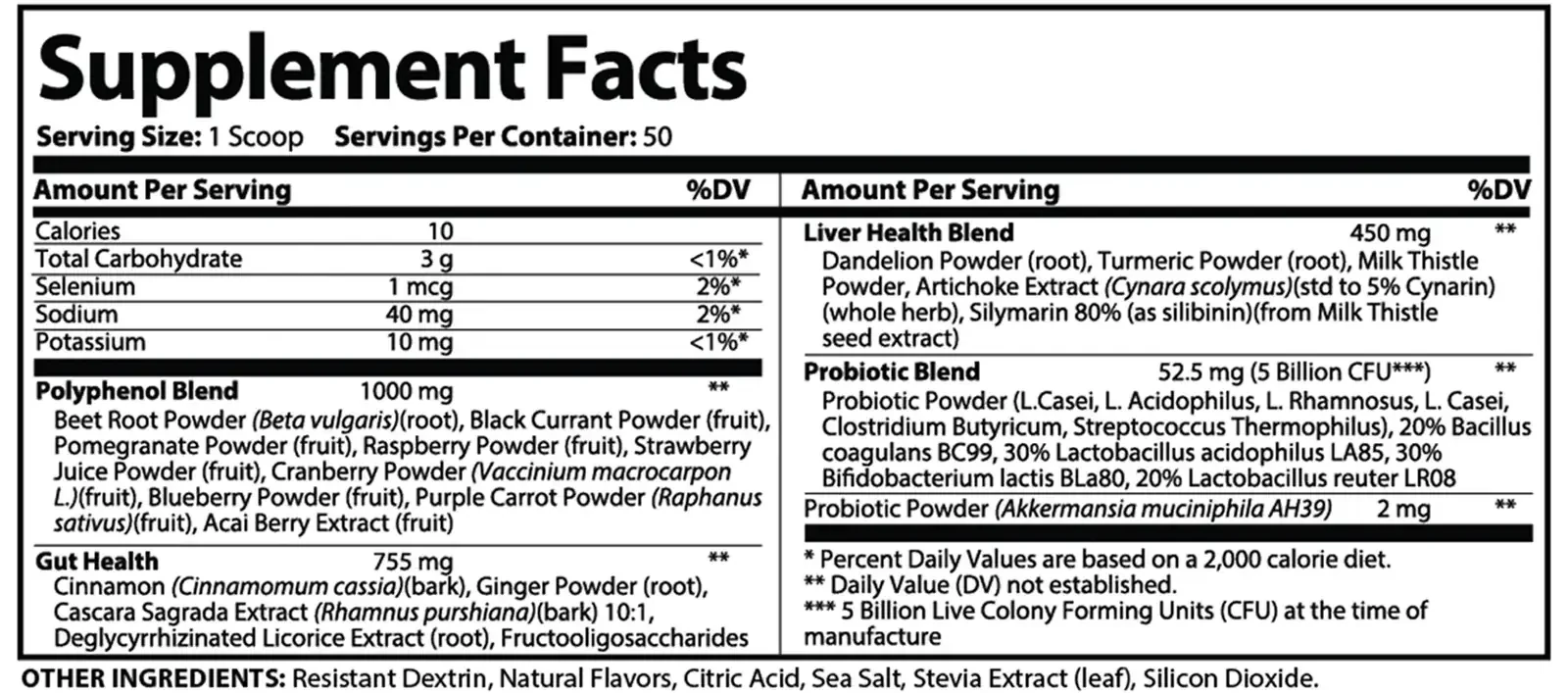
The Finessa polyphenol blend is 1,000 mg of nine fruit and vegetable powders, listed beet root first and acai berry extract last. It is the largest of the four blends, about 44% of the label's blend weights. Amounts are not printed, and trials of berries found no significant effect on gut bacteria.
Written by the Finessa label deskUpdated
The blend01
What is the Finessa polyphenol blend?
The Finessa polyphenol blend is the first line on the Supplement Facts panel: 1,000 mg of fruit and vegetable powders, nine lines in all.
Polyphenols are plant compounds that give berries and beets their deep colors. The panel does not list polyphenols in milligrams. It lists the weight of the powders themselves.
That detail matters. A 1,000 mg blend of powder is not 1,000 mg of polyphenols, and the research we cite measured phenolic content or used whole foods (Sweeney 2022, berry polyphenols and gut microbiota (RCT review)).
Of the 2,259.5 mg that the label's blend lines add up to, this blend is 1,000 mg, or about 44%. Those weights cannot all fit in one scoop, so read that share with care.
The nine lines02
Which fruits and vegetables are in the polyphenol blend?
Beet root powder comes first. Then come black currant, pomegranate, raspberry, strawberry juice powder, cranberry, blueberry, purple carrot and acai berry extract.
A blend must list its lines from most to least by weight, and print only the total (21 CFR 101.36 (proprietary blends)). So beet weighs the most, and acai the least. Single amounts stay hidden.
Black currant, raspberry, strawberry and blueberry are berries. Pomegranate and cranberry are tart fruits. Beet and purple carrot are roots. Acai is a palm fruit, and it is the only line sold as an extract.
- Fruit powders: black currant, pomegranate, raspberry, strawberry, cranberry, blueberry
- Root vegetable powders: beet and purple carrot
- Extract: acai berry
Blend math03
How much beet root powder is in a Finessa scoop?
At least 111 mg and at most 1,000 mg. The label gives no single amount, so nobody can say more from the panel alone.
Line k of nine weighs at most 1,000 mg divided by k. That is our arithmetic from the label order, not a lab test. The most beet could weigh is the whole blend, which would leave nothing for the other eight.
A more likely picture is a spread. If each line weighed the same, each would hold about 111 mg. Order alone cannot prove that picture.
| Place | Label line | Weight per scoop |
|---|---|---|
| 1 | Beet root | At most about 1,000 mg · at least 111 mg |
| 2 | Black currant | At most about 500 mg |
| 3 | Pomegranate | At most about 333 mg |
| 4 | Raspberry | At most about 250 mg |
| 5 | Strawberry juice | At most about 200 mg |
| 6 | Cranberry | At most about 167 mg |
| 7 | Blueberry | At most about 143 mg |
| 8 | Purple carrot | At most about 125 mg |
| 9 | Acai berry | At most about 111 mg |
| Place | Label line | Weight per scoop |
|---|---|---|
| 1 | Cinnamon (cassia) | At most about 755 mg · at least 151 mg |
| 2 | Ginger | At most about 378 mg |
| 3 | Cascara sagrada 10:1 | At most about 252 mg |
| 4 | DGL licorice | At most about 189 mg |
| 5 | Fructooligosaccharides | At most about 151 mg |
| Place | Label line | Weight per scoop |
|---|---|---|
| 1 | Dandelion | At most about 450 mg · at least 90 mg |
| 2 | Turmeric | At most about 225 mg |
| 3 | Milk thistle | At most about 150 mg |
| 4 | Artichoke | At most about 112 mg |
| 5 | Silymarin 80% | At most about 90 mg |
A blend must list its parts from most to least by weight (21 CFR 101.36 (proprietary blends)). The panel prints four blend totals and 2 mg of Akkermansia: 1,000 + 755 + 450 + 52.5 + 2 = 2,259.5 mg a scoop. The tub says 3.38 oz (96 g) and the panel 50 servings, which is about 1.92 g a scoop, so the printed weights do not fit inside one scoop. We do not know which number is off. Ask for the lot certificate of analysis. This is our arithmetic from the label, not a lab test.
Ask the order desk at +1 (302) 200-3480 for the lot's certificate of analysis. It is the only way to get measured amounts. See every label line for the other blends.
A label oddity04
Why does the panel print Raphanus sativus beside purple carrot?
Raphanus sativus is the Latin name of radish, not carrot. The panel prints it next to the purple carrot line.
Purple carrot is normally a form of Daucus carota. Radish is a different plant. We cannot tell whether this is a typing slip, a different purple root, or a radish-based powder sold under a carrot name.
The line is eighth of nine, so by our arithmetic it weighs at most 125 mg. A mix-up would change little in dose. It does show how closely the panel needs reading.
Check the panel on the tub you receive. If it still prints the radish name, ask the order desk what the powder is, and ask for the certificate of analysis.
We report this as a question, not a charge. Labels contain errors for many reasons.
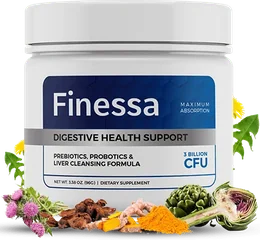
Finessa: from $39 a bottle50 scoops a tub · 1, 3 or 6 bottles · free US shipping on 6 · 180-day guarantee
See packsEvidence05
Do polyphenol supplements work for digestion?
The evidence is thin, and no study tested Finessa. Human trials of berries found no significant effect on gut bacteria.
A review of randomized trials found three that met its rules. Berries eaten for 8 to 12 weeks had no significant effect on blood pressure or gut microbiota (Sweeney 2022, berry polyphenols and gut microbiota (RCT review)). The authors asked for more trials.
Berries
Three trials, no significant gut-bacteria change. Black currant, raspberry, strawberry and blueberry belong to this group.
Beet
A meta-analysis used beet juice with 200 to 800 mg of nitrate a day, with low certainty. A powder in a blend is not that dose (Sweeney 2022, berry polyphenols and gut microbiota (RCT review)).
Cranberry
Studied for urinary infections, not digestion. Processing into tablets can reduce its key compounds (Sweeney 2022, berry polyphenols and gut microbiota (RCT review)).
Pomegranate, purple carrot and acai have no studied dose that matches a powder in this blend. The tub says "Digestive Health Support". For this blend we found no human trial behind that wording.
Safety06
Are the fruit powders in Finessa safe?
For most adults, fruit and vegetable powders are food-safe. A few have cautions worth knowing.
- Beets can turn urine or stool pink or red. That is harmless, but beets are also high in oxalate, which matters if you form kidney stones
- Cranberry has conflicting evidence on whether it interacts with the blood thinner warfarin. Ask your provider if you take it (Sweeney 2022, berry polyphenols and gut microbiota (RCT review))
- Pomegranate can affect how some medicines are processed. A pharmacist can check your list
- Fruit allergies still count. Skip the tub if you react to one of the nine
The bigger cautions sit in the Gut Health blend, where cascara is a stimulant laxative herb. Read cascara sagrada in Finessa first.
Do not stop, skip or cut a prescribed medicine because you started a supplement. Tell your care team before you add one (FDA, Mixing medications and supplements).
Takeaway07
Is the polyphenol blend a reason to buy Finessa?
Not by itself. It is a pleasant, food-based part of the formula, but its amounts are hidden and its gut evidence is weak.
If you like fruit and vegetable powders in a daily drink, this blend fits that. If you want a proven effect, no trial of it exists. Whole berries and beets cost little and have food-level evidence behind them.
The wider story is on the ingredients page, with a look at how Finessa compares with other types of product.
FAQ08
Finessa polyphenol questions
What polyphenols are in Finessa?
Finessa lists nine polyphenol-rich powders: beet root, black currant, pomegranate, raspberry, strawberry juice, cranberry, blueberry, purple carrot and acai berry extract. They share 1,000 mg, and single amounts are not printed. The panel gives no polyphenol content in milligrams.
How much beet root is in Finessa?
At least 111 mg and at most 1,000 mg a scoop. Beet is the first of nine lines in the 1,000 mg blend, and lines run from most to least by weight. That range is our arithmetic from the label order, not a lab test.
Is the Finessa polyphenol blend the same as a fruit serving?
No. A whole serving of fruit weighs far more than 1,000 mg shared among nine powders. The blend may add color and flavor, but it cannot replace food. Advice to eat fruit and vegetables still applies.
Why does Finessa list Raphanus sativus with purple carrot?
Raphanus sativus is the Latin name of radish, and purple carrot is normally Daucus carota. We do not know why the panel prints it. Check your tub, and ask the order desk for the certificate of analysis.
Do polyphenols change gut bacteria?
In trials of berries eaten for 8 to 12 weeks, the effect on gut bacteria was not significant (Sweeney 2022, berry polyphenols and gut microbiota (RCT review)). Larger, better trials are needed. Nothing we found shows that the powders in Finessa do it.
Does cranberry in Finessa interact with warfarin?
Evidence is conflicting (Sweeney 2022, berry polyphenols and gut microbiota (RCT review)). The cranberry line weighs at most 167 mg a scoop by our arithmetic, but ask your provider or pharmacist if you take warfarin or another blood thinner.
Is acai berry extract the last ingredient in the blend?
Yes. Acai berry extract is the ninth and last line, so it weighs at most 111 mg and no more than any line above it. Last place means the smallest share by weight, though the amount is not printed.
Can beet root powder change urine or stool color?
It can turn them pink or red, which is harmless. Black stools or blood are different and need a doctor the same day rather than a guess about beets (NIDDK, Constipation symptoms and causes).
Who wrote this09
Written and reviewed by
Pages built from the label, the sales page and linked NIH, FDA, CDC, FTC and peer-reviewed sources.
Last updated . Read our editorial standards and how we check reviews. This website is run by Gofinessa, a U.S. stocking partner for Finessa, not by the manufacturer. We earn money when you buy through our order links.
Keep reading
More about Finessa
U.S. stocking partner for Finessa
Ready to try Finessa?
Check the label against your medicines, then pick a pack. Six bottles ship free in the US and cost the least per bottle, and the guarantee runs 180 days.
- Secure checkout
- 180-day guarantee
- Ships from the U.S.